

Look at the Psalter world map, a delicious work of art, drawn with incredibly fine detail around 1260 by an unknown artist. In the upper part of the map the divine savior outstretches his arms to embrace the world. In the bottom lurk two dragons, symbols of sin which balance the divine presence. The sentence “hic sunt dracones” («Here be dragons») appears in medieval texts and maps to mark unexplored territories.
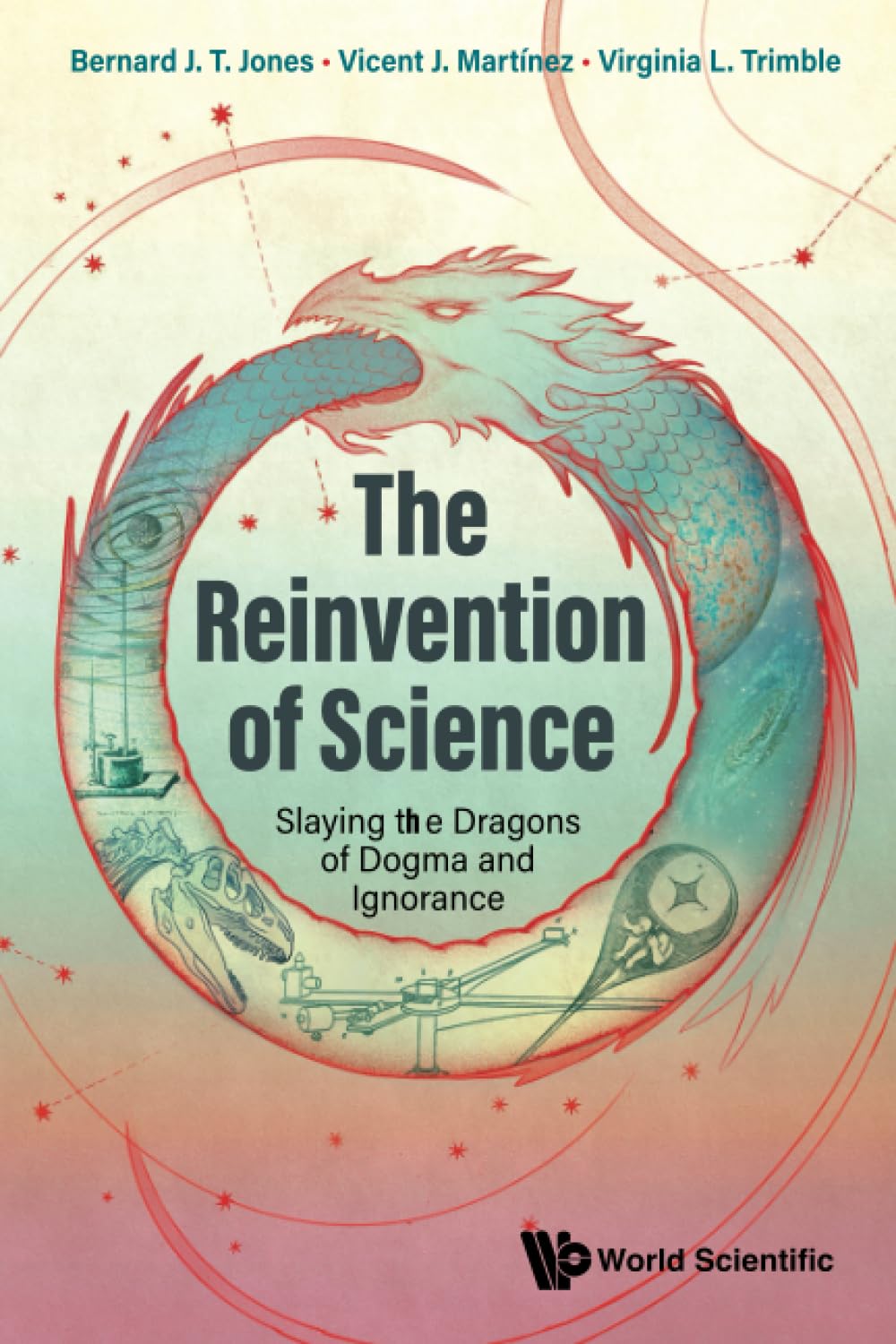
In their ambitious book The reinvention of Science, a triad of scientists (B.T. Jones, V.J. Martínez and V.L. Trimble) set themselves to the ambitious task of “slaying the Dragons of Dogma and Ignorance”. This fits well with the idea of erasing the “here be dragons” from the maps of knowledge. And yet, Bernard, Vicent and Virginia, turn out to be not only top astronomers, but also impenitent romantics. Dragons in their book, soon turn out to be main characters and they led us to follow them, from the instant they beak their way out of the egg to the moment they break into perilous flight.
One of the most attractive novelties that separates this opus magna from other major works is its impressionistic style. In the same way that a Monet may tell the same tale than a Bouguereau, and yet evoke very different emotions in the beholder, “The reinvention of Science” is an ambitious essay on the story of science, written for the educated, cultivated and curious reader. There are previous wonderful books on the subject such as “coming of age in the Milky Way (T. Ferris)”. But the latest is a classic, a Bouguereau, where beauty and intelligence, are, so to speak, ordered and contained. Rather, this monumental dragon treatise requires movement from the reader, like a Monet. You cannot stay still while reading. The narrative will not follow a predictable path, the time lines will mix and the book tidings will advance and retreat, as the story unfolds.
And the story starts breaking the dragon’s egg. Chapter 1 announces a predictable opening, “Ether and Atoms”, except that the first lines, rather than transporting the readers to Ionia, describe the most famous failed experiment of the history of science, that of Michelson and Morley.
What is so special about this experiment? Actually, how do the authors dare to start a book about the history of science with a failed experiment? How may accounts of failed experiments do you read in the press these days? Choose at random any piece of news about science and it will always be about some great, unexpected, game-changing, and possibly life-and-civilization threatening discovery (as everything related with AI goes these days). Actually, one could humor the authors of this book and claim that present day press is only interested in the dragons of science (big, mean, and fire-breathing), rather than in science itself.
Este artículo de nuestro archivo está completo para lectores registrados. Registrarse es gratis y solo lleva un minuto.


Ya veo que algún colaborador es capaz de presentar escritos en inglés. O de usar software de traducción automática.
En cualquier caso, pura pedantería por parte de Jotdown.
No lo voy a pasar por GoogleTraslator (enuy temprano y estoy muy resfriado), pero igual me animo y más tarde cancelo la suscripción.
Que os aproveche, sobraos
M’apunto.