
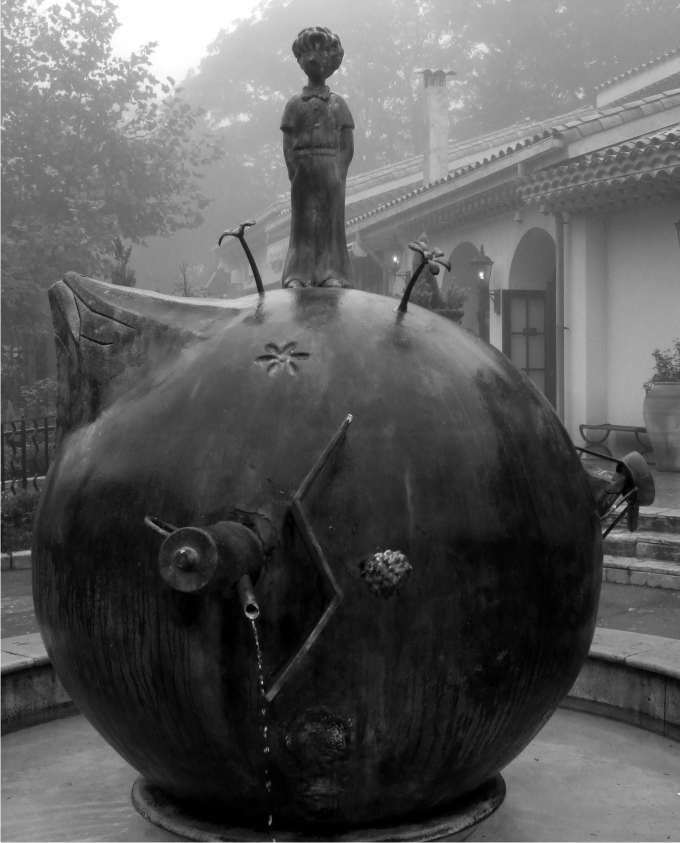
He was found dead in bed. There he was, like the Little Prince bitten by the snake. Now he is up on his asteroid, watching us with his philosophical irony from that silent and subtle place, tending the rose he loved, the rose of knowledge. His name was Werner Callebaut and I was privileged to have known him and to have shared laughter and knowledge in endless conversations that took us from Austria to Spain, from the United States to Japan, from Mexico to France. This is my small tribute.
Since the beginning of knowledge, humans have sought consistency; chickens and turkeys have too. Especially Russell’s turkey, a well-known parable by philosopher Bertrand Russell wherein, as retold in one of the multiple versions, our hero, the turkey, finds that every day life is full of delightful things, nurturing, and food from its master. Then December 24 arrives; that day the farmer, instead of bringing the bowl with the seeds and worms liked so much by Mr. Turkey, reaches out for it, wrings its neck, plucks it, and into the oven it goes.
Russell’s parable is a philosophical criticism of inductive knowledge. Imagine. Induction builds trust in the past as an explanation of the present and a representation of the future. But one day World War III begins and the next day we are all living in shelters; one day we are told that we have a terrible disease and the next, life in a hospital; one day we take a curve with our car, confident that all the curves we have taken to date are and therefore will always be the same empty curve in our lane, and a truck rushes in the opposite direction and hits us. One day the sun explodes and we are all dead without further ado.
Philosophy of knowledge searches for questions about how we face the difficult task of understanding the world and, for that, it develops answers to the causes of all natural phenomena. First there was animism, then mythology, followed by philosophy and religion. When science arose back in the Illustration, it was believed that everything would be achieved through reasoning, no absolute truths or dogmas of faith or sacred words. In turn of the century Vienna, where everything was buzzing, contemporary Western culture was in the making. In that space of waltz music; modernist furniture; Secession ambience; along the cedars of the baroque maze of the Augarten in the second district, where Arnold Schoenberg was born on the banks of the Danube Canal to establish the new foundation of music, some men are dedicated to making scientific epistemologies: no less than the Vienna Circle, der Wiener Kreis, a bunch of philosophers who drank from the juices of Poincaré, Wittgenstein and Popper, with their positivist philosophies about reality. And from that legacy have sprung the sources of knowledge of modern science: the belief that a nomothetic/deductive science leads us to know more and better about what happened, what is happening, and what will happen.
Este artículo de nuestro archivo está completo para lectores registrados. Registrarse es gratis y solo lleva un minuto.
Pingback: El pavo de Russell y la muerte del pensador