

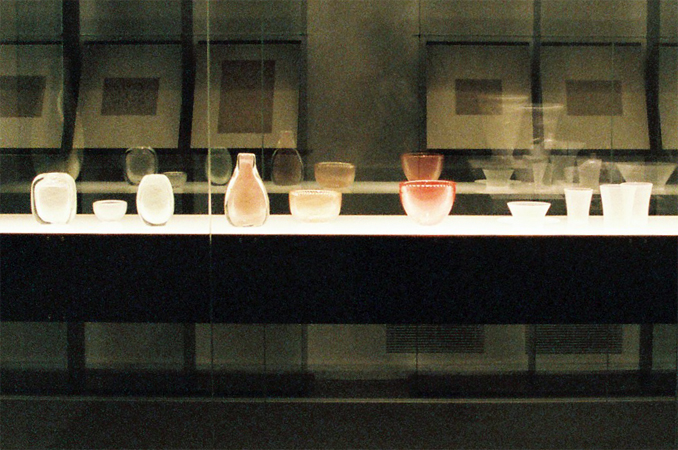
Venice hosts the thirteenth Architecture Biennale, under the title Common Ground as set by its curator David Chipperfield. Common Ground will remain open until November 25th. In the little island of San Giorgio Maggiore, away from the spotlights of the Giardini and the Arsenale, themselves epicentres of the architectural works exhibited in the Biennale; the glass works of the Venetian architect Carlo Scarpa are being exhibited in the show Carlo Scarpa. Venini 1932-1947, curated by Marino Barovier.
Whoever is not intrigued on knowing that there are people who make a living out of Arts of Fire, please raise your hand now. Arts of Fire, a name which seems to have been pulled out of the most capricious tale of magical realism, has little to do with fire breathing or dancing, or even correfocs (1), although this would perhaps add even more beauty to the idea of a fire artist (2). Instead, Arts of Fire are constituted by the practice of ceramics, glasswork and artistic jewelry, in which the Mediterranean territories have excelled throughout the centuries. From Moroccan mosaics to Gaudí’s trencadís, from Portuguese or Valencian ceramics to Venetian glass; all the way to contemporary practices of artistic jewelry that are being carried out by numerous national and international artists; these pieces present a distinctive warmth and humanness. The aforementioned arts take their name from the processes employed in the manufacturing of these pieces, which require the use of fire, which is applied in one way or another.
It is often that the competencies of the Arts of Fire intersect with those of architecture; their relationship having been in constant tension since architecture is understood as such. Nevertheless, it is difficult not to acknowledge that an architecture that has been crafted with care is a warm architecture, as the crafted piece has been worked in a direct relationship with its materiality. As a result, the architecture has a scale which could be said to be more tangible. The best (and ceramic) example, is the brick unit, which, either glazed or not, has been specifically designed to be laid with one hand, while the other applies the mortar. A brick wall has a texture that not only entertains the eye, but also reduces its scale. Carlo Scarpa, the object of the exhibition described in the first paragraph, is also a good example of a professional who managed to create a dialogue between architecture and the Arts of Fire, the art of glass to be precise. Ceramic and glass pieces insert real or fictional stories in the architecture that contains them; they tell stories of material tension and are witness of a process of artisanal creation.
Este artículo de nuestro archivo está completo para lectores registrados. Registrarse es gratis y solo lleva un minuto.

Pingback: Jot Down Cultural Magazine | Réquiem por las artes del fuego