

(Versión en castellano aquí)
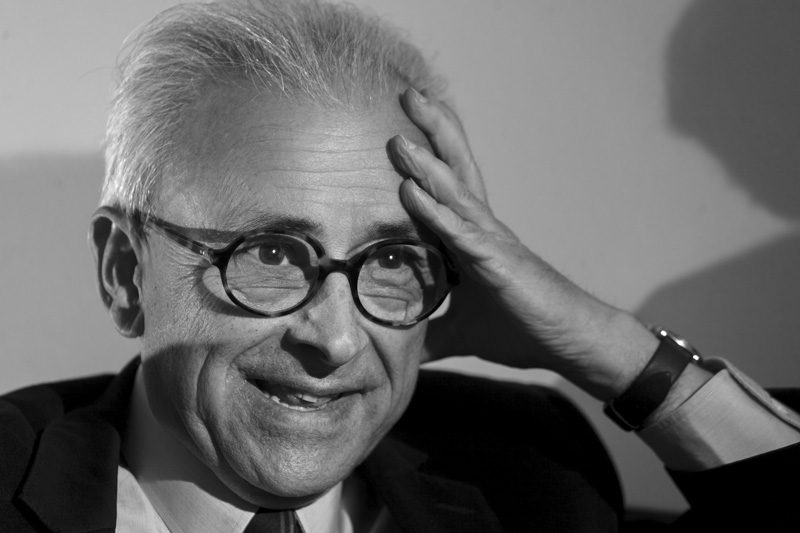
From young António Damasio (Lisbon, 1944) interested in becoming a filmmaker to today’s neurologist and researcher expert in emotions there’s a smaller gap than what anyone could imagine. This scientist and writer has always been interested in Humanities and the study of feelings. Every single book of his shows this interest which goes beyond the disciplines and addresses one of the most central aspects of our humanity. Descartes’ error, Looking for Spinoza or Self comes to mind reflect a great passion to understand where affection, emotions and feelings which shape our life and make us who we are are born.
We take advantage of Damasio’s visit to Spain during the launching of his last book , The Strange Order Of Things, to meet him in La Pedrera and talk about his many and diverse interests. Cinema, literature, memory, philosophy and –obviously- emotions show up while we talk with a Damasio fond of Shakespeare’s, Proust’s, Hitchcock’s and Welles’ work. Especially Welles. Because the answers to many of his questions cannot be found only in labs. Quite often, cinema, like literature or music, can give us a more accurate portrait of human emotion that any scientific study.
Emotions and feelings are at the centre of everything human. It’s funny how fast we forget it.
It’s not just funny, it’s amazing that we forget so easily because we don’t pay attention to something that is so central. I think it has a lot to do with our culture. Our culture has emphasized so much the knowledge of objects and actions and the knowledge that comes from science that you end up forgetting this reality, the one in which you and I are right now. It’s something that has to do with the foundations of our life, it has to do with regulation, it has to do with how we feel. Then on top of it comes this big edifice of culture, in the tradition sense, and it obfuscates. It’s a mixture of forgetting and covering. We are covered by knowledge, we are drowned in knowledge. And from the point of view of the humanity that’s actually not good.
Which feeling moved Antonio Damasio to study the feelings?
That’s an interesting question because I think I have always had an interest in feelings given my old interest in humanities. I grew up, actually, very interested in the human mind in general. I didn’t know I was going to become a neuroscientist, because when you are ten or twelve you don’t know these things, but I knew I was interested in literature, I knew I was interested in cinema… In fact, for many years I thought I might become a film director or a writer in general. Then I discovered that there was something called neurology -it wasn’t even called neuroscience then-, and with neurology what people were trying to understand was the mind. And that’s when I went to medical school and became a neurologist. For a long time I studied language, memory… Practically, the first project of my career was myself and my wife. Fundamentally, we studied perception, language and memory. And then, at a certain point, my interest in emotion came back because of the patients I was studying. I made a complete inflection and it’s not that I stopped studying the other things, but I turned my lab totally in the direction of studying the emotion. And then it became one of the main labs to work in emotion, feeling and decision-making related. It’s an old interest that the became very targeted. It’s quite curious because our work had been very well received in terms of language and perception so far, and people said “don’t study emotions, it’s of no interest”. People had this cognitive bias, and said that “you are going to destroy your career.” And, of course, it’s the opposite, it was the right decision. I should have done it earlier.
Este artículo de nuestro archivo está completo para lectores registrados. Registrarse es gratis y solo lleva un minuto.



Pingback: The value of emotional intelligence in compliance audits | IMAGO
Pingback: El valor de la inteligencia emocional durante auditorias de cumplimiento | IMAGO
Pingback: La valeur de l’intelligence émotionnelle lors d’un audit de conformité | IMAGO
Pingback: Psychosocial risk factors in the auditing context | IMAGO