(Versión en español aquí)
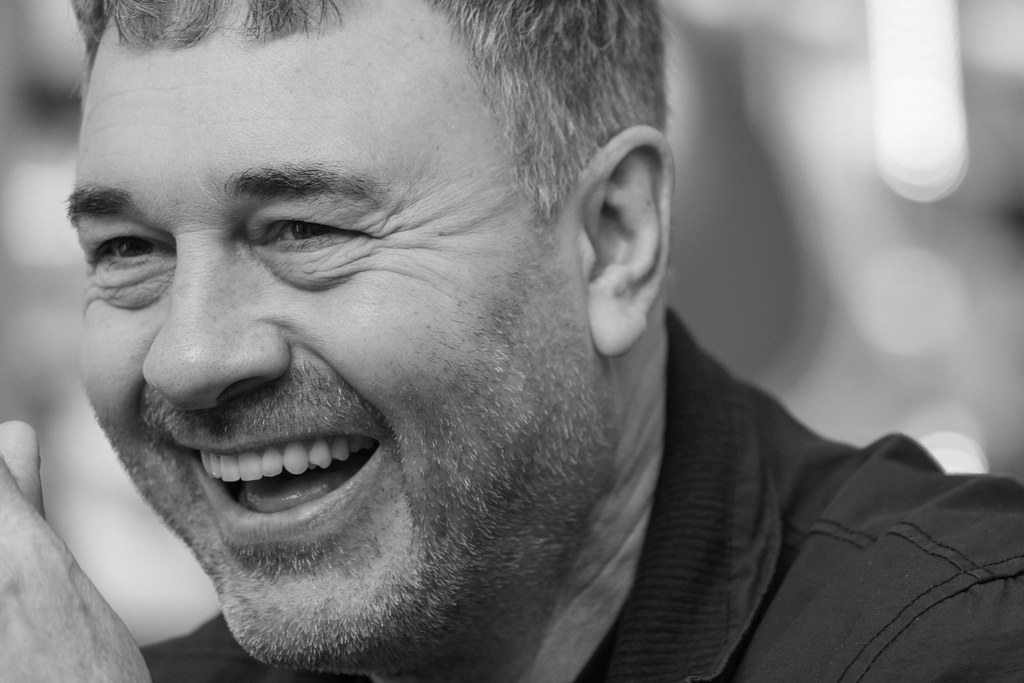
People say that succeeding with the publication of a first work can become the worst burden for a writer. Whether this is true or the justification of the most envious, Richard Morgan (London, 1965) does not seem to have fallen into this trap. After the appearance of Altered Carbon, he has not stopped working on multiple novels, comics and video games without losing the public’s attention. The icing on the cake came from the hand of Netflix and the production of the series of that first work, a cyberpunk noir with a lot of transhumanism and interesting reflections on immortality or the limits of the self.
We take advantage of his participation in the first edition of Festival 42 to lock him in the Librería Gigamesh and ask him about his life and work, and without realizing it we see ourselves arguing about the relationship between neuroscience and philosophy, the failure of the Labor Party in the last elections or the circus that the Musk, Zuckerberg and company are putting together with their idea of turning classic science fiction into realities perhaps too far from, well, reality.
You’ve been in Barcelona these days as one of the big names at Festival 42. Although you were already a well-known author since the publication of «Altered Carbon», has the Netflix series put you in the focus of the mainstream?
Yes and no. I mean, yes in the sense that while the show was live, you know, when it first launched and it was being marketed and so forth, I got a lot of mainstream attention. I was interviewed by the Guardian and various other broadsheet newspapers. You come to the attention of the world when something like that happens. So that was nice, but it didn’t last. Media works that way towards the next thing. So that lasted for most of 2018 but by the end of the year it was already starting to drop again. There were questions about whether there was going to be a second season of the show. Also the show got mixed response from the critics. Generally people who watched it loved it, but the critical response was certainly mixed. And then I was again just a well known science fiction writer. It still works for me when I meet people at parties. That gives you a kind of general visibility that I think books will never do. I think that’s just about screens. Anything that’s video entertainment such as a video game or a movie or a streaming show… the footprint of those occupies so much more than any kind of novel. I had people ringing me up and saying, ‘Oh I was in Calcutta and I saw this huge poster of Altered Carbon’. In that sense, screen entertainment always has the edge. It’s sexier. It’s more impactful. It reaches a wider audience and as a writer, you’re aware that you’re sort of the poor cousin of the family.
Este artículo de nuestro archivo está completo para lectores registrados. Registrarse es gratis y solo lleva un minuto.