English

Against Purity: Why Maria Popova Is Wrong About Poetry and Artificial Intelligence in Claiming That ChatGPT Can’t Move Us Like Walt Whitman

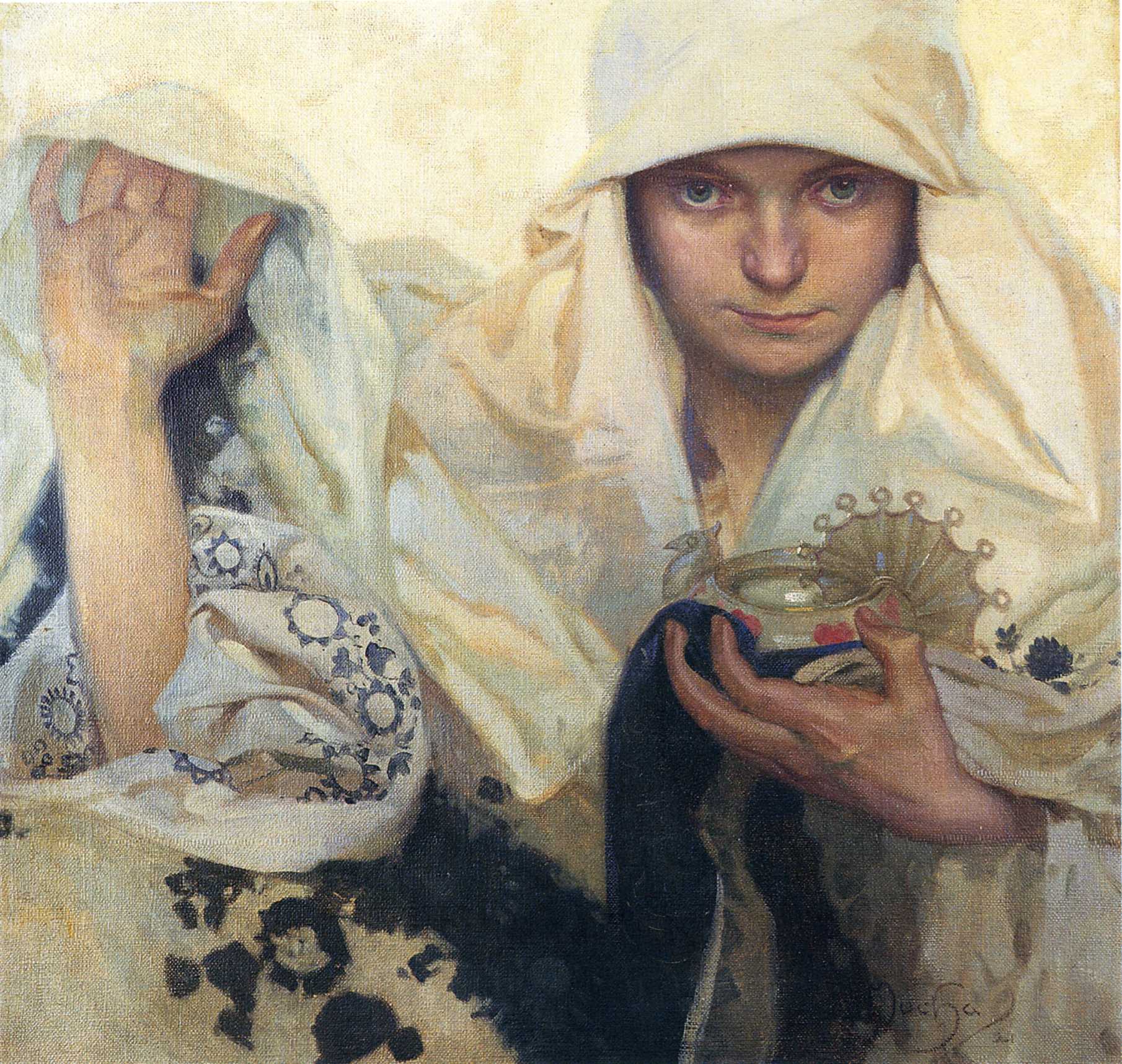
«Destiny» (1920), by Alphonse Mucha.

I’ve been reading Maria Popova for years, with the kind of admiration that turns underlines into quiet rituals. Her essays have moved me, surprised me, and stayed with me—the kind of writing you return to like a well-worn book or a half-remembered dream. At Jot Down, we’ve had the privilege of translating and publishing several of her pieces with her blessing, always trusting that her way of looking at the world helps expand it. A few days ago, she published a reflection titled “Uncoding Creativity in the Age of AI: What Makes a Great Poem, What Makes a Great Storyteller, and What Makes Us Human” in which she argues that no machine could ever write a truly great poem.

Maria Popova is a singular presence in Anglophone cultural life. Born in Bulgaria and now based in the U.S., she has turned her website The Marginalian (formerly Brain Pickings) into a kind of digital sanctuary, where philosophy, literature, and science converge—everything filtered through an unwavering devotion to beauty, as she understands it. Her prose, both elegant and approachable, conveys a contemplative sensitivity that has drawn millions of readers searching for meaning, depth, and aesthetic refuge. But that sensibility, like all lofty moralities, has its blind spots. At times, it risks slipping into a kind of emotional catechism, where melancholy masquerades as depth and reverence as truth.

Her recent claim—that AI will never write a poem worthy of Walt Whitman—belongs to this genre of philosophical comfort food. Popova recounts asking ChatGPT for a Whitman-esque poem about a solar eclipse. The result didn’t move her: a string of predictable rhyming couplets, lacking awe, devoid of resonance. Her conclusion is stark: AI possesses language, but not experience. Whitman, by contrast, could carve out emotional galaxies with ordinary words. Because the machine cannot suffer, it cannot make art. A poem, she declares, is made not of words, but of pain. And pain, like consciousness, is uniquely human.

It’s a seductive idea, but also a deeply naive one.

The fact that AI does not suffer doesn’t mean it can’t produce art. This mystical link between pain and beauty is a romantic inheritance—charming, but flimsy under scrutiny. Homer didn’t need to lose a child to write Achilles’ wrath. Shakespeare didn’t have to die of jealousy to give us Othello. Emily Dickinson barely left her house, yet wrote eternity. Art is not a direct transcription of trauma, but its transformation. Its form. Often, it’s a lie more beautiful than any lived truth.

Popova’s demand that poetry be born of suffering forgets something fundamental: literature has always been an illusion. A masquerade. An artifice. Writers are not just victims of their biographies—they’re architects of fictions. The great poet is not the one who suffers most, but the one who shapes life (or imagination) into a structure of language that moves others. This is where AI enters—not as a substitute for the artist, but as their extension.

Because AI is not, and will never be, a poet. But in the hands of a poet, it can be a formidable instrument.

ChatGPT has no body, no fear of death, no desire. But it does have memory—ours. It’s trained on our works, our prayers, our insults, our finest metaphors and worst clichés. Its voice is a hyperbolic mirror of our own. And like all mirrors, it can distort—but also reveal. AI doesn’t create in a vacuum; it multiplies what you bring to it. It’s a creative amplifier. It doesn’t replace thought—it magnifies it. It doesn’t feel experience—it recombines it. It has no taste, but it can help refine yours, like a tireless editor.

The real difference, then, lies not in the machine, but in its user. In gifted hands, AI elevates. In unskilled ones, it degrades. If you write without intention or style, it will only echo your inertia. But if you know what you’re after—if you have something to say—ChatGPT becomes a microscope for your own intuitions. A lab bench for language. A chamber of echoes. Writing with AI isn’t the end of being human. It’s a new expression of it. Or rather, a transformation: we are no longer merely human. We are transhuman.

That’s the quiet revolution Popova resists: ChatGPT has already changed us. Not as a threat, but as an extension. We are bodies with smartphones, minds with search bars, fingers on keyboards. No one writes alone anymore. No one reads alone. No one thinks alone. If you write in Word and edit with Grammarly, you’re already partially machine-assisted. If you storyboard with an app, or look up synonyms suggested by a neural net, you’ve crossed the threshold. There’s no going back. And that’s not tragic—it’s simply what’s next.

Back to that eclipse poem. Popova found it bland. Perhaps it was. But are there not thousands of human poems just as bland? Isn’t literary history teeming with forgettable verses, pale imitations, classroom exercises? That ChatGPT produces mediocre poems doesn’t make it alien—it makes it familiar. What it lacks isn’t soul—it’s editing. Discretion. That elusive thing we call taste. As Wilde said, taste is a very complex form of intelligence. AI has no taste because it has no desire. But you do. And with desire comes the ability to reshape, to refine, to make something your own.

In this, AI resembles photography. When the camera arrived, many painters (and critics) announced the death of painting. Why render reality when a machine can capture it more precisely? And yet—Impressionism, Expressionism, Abstraction. What mattered wasn’t fidelity to the real, but fidelity to a gaze. To the eye. The same is true of language. It’s not whether the machine writes better than you—it’s whether you use what it gives you to see differently.

Popova’s argument, elegant as it is, rests on essentialism. That old reverence for the soul as the singular origin of art. But cultural history isn’t pure. It’s a history of remixing, theft, parody, adaptation. Don Quixote mocks the romances that came before it. Ulysses is a rewriting of Homer. Borges wrote stories about books that don’t exist. Isn’t that what AI does—assemble the past into something new? Until now, only humans did that. Now we share the process. And that sharing forces us to reconsider authorship, genius, even creation itself.

This isn’t a threat—it’s a challenge. Popova faces it with nostalgia. But we might just as well face it with ambition. What if AI doesn’t destroy art but expands it? What if it pushes us to be better? To write sharper. To think deeper. To define ourselves not by what we do, but how well we do it.

Underneath Popova’s concerns lies not a technical fear, but an existential one: the fear of losing our specialness. Of seeing poetry—our final redoubt of the soul—profaned by a faceless server. But that fear is unfounded. What makes a poem great isn’t who wrote it—it’s what it does to the reader. Whether penned by a farmer, a bourgeois, or a bot, what matters is that it moves you. Stops you. Changes you. If an AI ever achieves that—suffering or not—it will be art.

Popova resists this because she holds suffering as sacred. As if only those who have wept may speak of tears. But that denies fiction itself. Empathy. Imagination. Actors are not required to kill to play Macbeth. Writers need not be enslaved to write about slavery. First-hand experience is one path—but not the only one. And AI, trained on the sum of human memory, partakes in that same raw material. It doesn’t live—but it remembers. It doesn’t feel—but it reflects. And used well, that can be powerful indeed.

The question, then, is not whether AI can create art—but whether we can use it as part of our expressive force. What’s at stake is not the soul, but intention. AI is no enemy and no replacement—it’s a continuation. An added organ. A human upgrade. An adjacent intelligence which, when paired with prepared minds, doesn’t weaken us—it elevates us. ChatGPT won’t write your novel. But it can help you think more clearly, experiment more boldly, chart paths only you can walk. It’s a notebook without end. A mirror for your style. A springboard for your voice.

Like all transformative tools, it doesn’t generate talent—it magnifies it. It won’t invent what you don’t already carry, but it can accelerate your search. If you have a voice, it will amplify it. If you have confusion, it will echo it. That’s the truth Popova doesn’t say: AI doesn’t distribute sensitivity evenly—but it does demand more skill. The real divide is not between humans and machines, but between those willing to evolve and those who entrench. Having lived deeply or suffered keenly is not enough. You still need form. Clarity. Vision. That has always been rare. But now, those who possess it can go further. Because with tools like this, we are no longer merely human. We are something more.

With ChatGPT, we are already transhuman. Not in the bionic sense of Frederik Pohl’s Man Plus, but in a subtler, more radical way: we’ve grafted an external intelligence onto our thought process—a second cortex made of language, not neurons. Not embedded in our skulls, but carried in our pockets. Like a yogi stretching his senses, like a musician composing with synthesizers, like a poet who dictates instead of writing. Art, like life, adapts. Popova longs to preserve an ancient idea of purity. But purity was never the engine of art. If anything, it was its enemy. Let the eclipse come. Let whoever can, write it. What matters is that, upon reading it, we still feel awe.

SUSCRIPCIÓN MENSUAL

5mes
Ayudas a mantener Jot Down independiente
Acceso gratuito a libros y revistas en PDF
Descarga los artículos en PDF
Guarda tus artículos favoritos
Navegación rápida y sin publicidad


SUSCRIPCIÓN ANUAL

35año
Ayudas a mantener Jot Down independiente
Acceso gratuito a libros y revistas en PDF
Descarga los artículos en PDF
Guarda tus artículos favoritos
Navegación rápida y sin publicidad


SUSCRIPCIÓN ANUAL + FILMIN

105año
Ayudas a mantener Jot Down independiente
1 AÑO DE FILMIN
Acceso gratuito a libros y revistas en PDF
Descarga los artículos en PDF
Guarda tus artículos favoritos
Navegación rápida y sin publicidad
 

Deja un comentario

Tu dirección de correo electrónico no será publicada. Los campos obligatorios están marcados con *

*