

Report made with the support of Intermón Oxfam
In the community of Aguascalientes, in the Polochic Valley, an idyllic place northeast of the capital of Guatemala, roosters wander aimlessly and crow at the wrong time with harsh voices. They must feel the sadness of the people, campesinos (peasant farmers) forced off their lands in March 2011 by the company Chabil Utzaj (The Good Harvest). They are Q’eqchi’ Maya; evicted from the land where they planted corn, beans, chili peppers, and cardamom. For them, the ex-dictator José Effraín Ríos Montt and the absolute power he represents is not a distant past, but a continuous present.
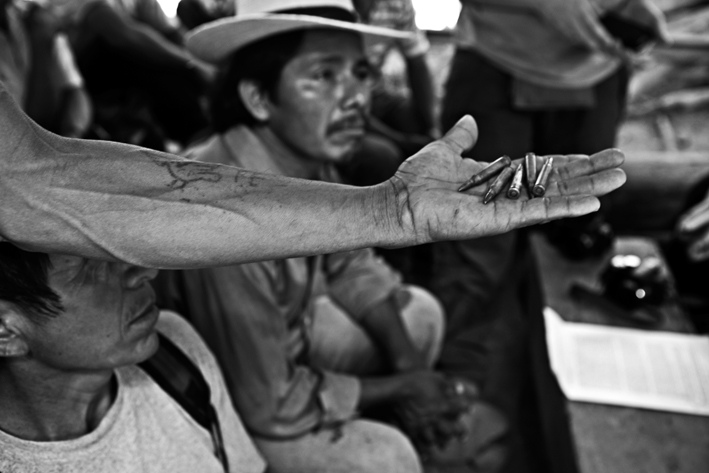
Enrique Quibb shows the five bullets he picked up from the ground during the takeover of Aguascalientes. His hand is firm but his voice breaks with emotion. He speaks of armed soldiers, violence, trucks hauling people away like cattle, stolen lands, and humiliation. It is hard for him to keep back the tears.
Juancho Chokool is missing his right leg. In the shade of a tree he listens to Quib’s story, leaning on his crossed crutches. His mouth, half-open, is frozen in an expression of anger. Juancho is a sailor, in charge of navigating the Polochic River in a wooden canoe that has leaks in every corner. The campesinos want to show the destruction caused by Chabil Utzaj, owned by the Nicaraguan multinational Grupo Pellas.
They describe how on the other side of the river heavy equipment razed their crops of corn, beans, and chili peppers just two weeks before the harvest. Although the land belongs to the company, Guatemalan law states that the first one hundred meters of the river bank are public land. No one reports Pellas to the authorities. No one believes anything will be done in a country without a land registry or rural courts and where 97% of homicides are left unpunished.
The landscape is beautiful with the Sierra de las Minas Mountains in the distance, the objective of concessions of eager mining companies. Some people cross the river on foot in a shallow zone. The water comes up to their waist; they raise their arms in the air like prisoners. Candelaria points at some land that has been dug up. “What do they get from taking our food? What harm have we done? Why don’t they just let us live?”. Shortly after a small red plane owned by the company takes off. It flies around in low intimidating circles. Its purpose is to frighten off invaders, what they call the evicted farmers who resist giving up their land. A shot is heard in the distance, the echo of the valley returns another shot.
Este artículo de nuestro archivo está completo para lectores registrados. Registrarse es gratis y solo lleva un minuto.

Pingback: Jot Down Cultural Magazine | Guatemala, la transición requisada