


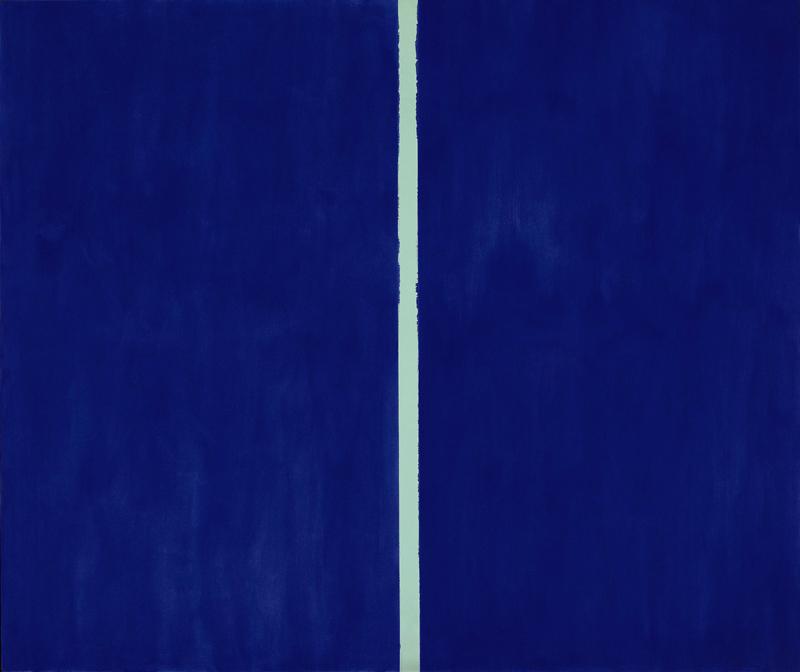
What do you think about the painting above? Some artsy-fartsy bullshit, don’t you? Then prepare to be outraged upon knowing that someone just paid 34 million euros ($ 45.07 million) for it. Mind you, New York Sotheby’s advertised it as «a portal to the sublime.» They had to be kidding, right? But if it’s just a dark blue square with a light blue stripe across. These contemporary art people are completely deluded. Come on, my little nephew could paint that picture in front of your eyes.
No, he couldn’t.
Neither my nephew nor you could paint it. Not even a competent artist without having gone through the researching creative process that led to this particular painting. Copying it, at best. At best.
It’s funny, but we often feel a deep annoyance about the money for some artwork is sold, especially the abstract ones. But therein lies one of the main problems: the value or importance of an art object couldn’t –and mustn’t- be compared to its market price. This is an intellectual aberration and a mistake on the approaching basis, because the criteria governing art market are absolutely different from those of the artistic quality. In fact, they usually are completely independent and move closer to those of stock market or real estate speculation.
Furthermore, the same outrage we feel doesn’t seem to be as strong when knowing, for example, that Real Madrid paid 96 million euros for Cristiano Ronaldo. You’ll surely say that Ronaldo is a special person, a unique player; he throws knuckleballs with his feet, runs like a sprinter and has skills that are almost otherwordly. In short, he does things the common mortal can only dream about.
Well, let me put another case in point:
Easy to copy, impossible to do. Guti, with a very simple backheel, turns a 1 on 1 into a 1 on zero. He does something that nobody has done before, something that no one has even dared to think before. He pushes the limits of football; he pushes the edges of his world.
With a very simple backheel.
Because that’s exactly what this whole art thing is about: pushing the edges of the world. And art has thousands definitions: that of Thomas Aquinas («Art is the right ordering of reason»), Adolf Loos («Art is the freedom of genius»), or Jean Dubuffet («Art is novelty»), but I don’t know which one is the most valid, or if they all are. Nor do I know whether to raise something to the category of «art» indeed raises it; that is, if an art object is inherently better than a mundane one. I don’t even know if art and beauty, so closely united over history, are actually dependent, interdependent or independent.
Este artículo de nuestro archivo está completo para lectores registrados. Registrarse es gratis y solo lleva un minuto.


Pingback: ¡Han pagado 34 millones de euros por un cuadro abstracto! Y otras obras de arte que podría hacer mi sobrino de siete años
If you have read it, what do you think about this book http://www.goodreads.com/book/show/15929764-what-are-you-looking-at ?
For a me it was amazing to discover the purpose of many paintings, sculptures or performances. Even I enjoyed some of them. After discovering Cut Piece, I will never look Yoko Ono with the same contempt.
I haven’t read it, but it surely seems pretty interesting.
I’ll check it out as soon as possible.
Thanks and regards.
There is a fundamental difference between ‘Onament VI’ and the other examples (including the football backheel) – it’s not clever and it doesn’t look like much effort was put into it.
As such the other examples don’t look like they were made by a seven year old, even if they could have been.
That’s probably the part that enrages people, myself included.
I’m not totally sold on that «effort» concept. I mean, Inci’s or Soo Sunny Park’s works are made with clearly lost of effort, but do you really think is that much «effort» in the Scattered Crowd by Forsythe or the mirrored room by Thilo Frank?
Regards.
I wanted to say «lots of effort» and not «lost of effort».
My bad.
I mean, the effort is clear in every example, but it’s not necessarily «physical» effort.
No of course not, I wasn’t implying the effort is physical, more along the lines of that it’s creative and thought was put into either the execution or preparation and seems like more action was involved.
I’m not saying Onement VI was done in 15 minutes spontaneously with ‘no fucks given’, but that’s what it looks like, certainly compared to the other examples.
I mean there’s a reason people are angry that such paintings make so much money, I’d say this is it – they don’t see the effort, visual appeal or creativity behind it and hence don’t see why it would be so valuable.