
Versión en español aquí
When my family and I left Spain in 2021, we left behind a future we could no longer reclaim and a past woven from Iberian dreams, encounters between cultures, and friends who had become family.
To say it was a painful loss would be an understatement, and I shall return to this later. At least we had had the opportunity to get to know and fully embrace Spanish culture. As the poet Alfred Lord Tennyson said: ‘It is better to have loved and lost than never to have loved at all’. A decade after the EU referendum, I fear many of my fellow countrymen remain unaware of what we have lost. I say this from experience: freedom of movement was a passport to another life.
I first became familiar with Spain thanks to my father. He was an English lawyer specialising in maritime law; he represented Astilleros Españoles and counted his clients amongst his closest friends. Generally speaking, his Spanish was dreadful (although he had a strong command of culinary vocabulary). Even so, his deep love for the country was infectious.
He took me to Seville in 1991. The Expo was about to begin, and the city made an instant impression on me: its beauty, its ochre sands, the scent of orange blossom, its people, its warmth. I was thirteen years old and I remember meeting some girls my age dressed in trajes de flamenca on the banks of the Guadalquivir. They were graceful and approachable, and I was frustrated that I couldn’t communicate properly with them. I made a mental note: ‘One day I must learn Spanish.’
It was a fleeting thought: I got back to London and all but completely forgot about it. But ten years later I became a teacher of English as a foreign language (TEFL) and, in January 2001, taking advantage of our right to free movement, I set off for Seville rather on a whim. I was twenty-three years old and knew just one phrase in Spanish, a line from Buena Vista Social Club: ‘El cariño que te tengo, yo no lo puedo negar’ – essentially: ‘I cannot deny the love I have for you’. Two weeks into my stay, I attempted to say it to a poor girl in the Plaza de la Alfalfa. I don’t think she understood me, but I never looked back. I got a job as a teacher at an English language school, and in the afternoons and evenings I played at being Sevillano.
From Seville, I travelled down to explore Cádiz, its light and its sea, and from there I went on to spend the rest of my trip in Granada. Before going to Spain, I had studied law and had been offered a training contract with a London City firm. I was down to start that same year, but now enchanted by the Albaicín, I asked to defer my start date by another year, and to my delight, they agreed. Pure euphoria.
By now I had fallen in love with the language, with flamenco, with the poetry of the mighty Generation of ’27 (in other words, I had become the classic Spain-obsessed Northern European). I wanted to delve deeper into all of it, so I went to Salamanca to study. There was a special programme that allowed me to enrol in Hispanic Philology for a year; at the same time, I had the opportunity to obtain the DELE Superior certificate.
Salamanca left its mark on me. I threw myself into it headfirst, and my new friends never missed an opportunity to rib me with comments like ‘Ignore “Little Tomato”’ – a reference to the flamenco guitarist; I had learnt to play flamenco guitar (extremely badly) – ‘This bloke’s doing a Hemingway! ‘Here comes the English-Andalusian!’, and so on. Looking back, that period deepened my love for language and made me think, for the first time, that someday I might become a writer.
At the end of 2003, I returned to London to start working as a commercial lawyer. It wasn’t the right fit for me, so I became a barrister and began focusing on human rights and immigration law. Whenever I could, I’d escape to Spain – to the point where my friends in the South began calling me “the ambassador of Andalusia.”
When I met my wife, Sarra, I travelled with her to Cádiz, and in late 2016 – a few months after the Brexit referendum – we bought a small house in Vejer de la Frontera, which we shared with my parents; we each contributed 50% of the price. The main idea was to strengthen our connection to that region that appealed to us so much.
For similar reasons, Sarra and I decided to get married in Vejer: with its Moorish history and views of the Strait of Gibraltar and Africa, it was a sort of middle ground between the world of her Sudanese ancestors and that of my British ones.
In 2017, Sarra gave birth to our first daughter, Yasmín, and in 2018, while she was on maternity leave, we moved to Vejer. It was supposed to be just a couple of months. However, while we were there, a paediatrician position came up in Gibraltar, and partly out of fear of Brexit – that we might never have a similar opportunity again – we decided to stay and live in Spain. The plan was to try to obtain permanent residency and, eventually, Spanish citizenship.
Little by little, I scaled back my work as a lawyer. I stopped taking on so many long-distance cases and, instead, devoted myself to caring for our daughter while Sarra settled into her new job. I also began writing a novel about the world of refugees and – naturally – about Southern Spain. I’m pleased to say it was published last year. It’s called Sanctuary, a reference to the Costa de la Luz.
We began radically to reorganize our lives. Our hope was that our daughters would grow up with an identity rooted in the fusion of our families’ two worlds – the Arab world and the Christian world – and for that, there was no better place than Andalusia.
Those were three wonderful years. We wanted to live in Spain long-term, so we registered, paid into Social Security, and took care of all the paperwork so that we could, someday, become naturalized citizens. With no exaggeration, it seemed to me that Spanish culture –which had so fascinated my father, Sarra, and me – was the greatest gift we could give our daughters.
Our second daughter, Lucía Azahar, was born in Puerto Real in May 2020 – in the middle of the pandemic – and, despite everything, it was a wonderful experience. However, everything was about to change.
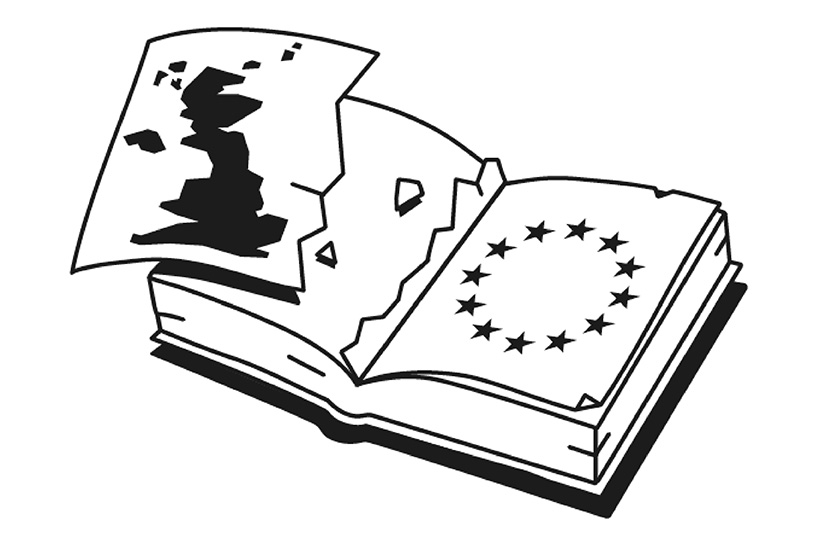
In 2021, the United Kingdom left the European Union (EU) and became a ‘third country’: among other things, British citizens lost the right to free movement within the EU – a right that my family and I had enjoyed for so many years.
In principle, we were protected from the effects of Brexit because we were in Spain exercising our right to free movement when the United Kingdom left the EU. However, for various reasons, that wasn’t the case.
Unfortunately, the paediatric team in Gibraltar where my wife worked underwent a radical change, and two of her colleagues left their positions, which made her employment situation feel unsustainable. It all happened very suddenly.
Meanwhile, my father was diagnosed with terminal cancer, so in 2021 we made the painful decision to move northwards. My wife landed a great job here in Guernsey – an island in the English Channel, between Great Britain and France, with good transportation links – and we’ve been here ever since.
To be clear, we had absolutely no desire to leave Spain. The hardest part was knowing that, because of Brexit, by leaving we weren’t just leaving the country, but also a life there and everything that lay ahead of us – especially for our daughters. We were less than two years away from obtaining permanent residency. After everything we’d been through, we realized that no matter how much we might want to return someday, we would no longer be able to settle in Spain in the same way.
The window of opportunity had closed.
And all because of a decision called ‘Brexit’, which to this day seems to lack any clear rationale and was achieved, at least in part, by lies. As Stephan Lewandowsky, a researcher specializing in disinformation at the University of Bristol, noted in an article published on July 4, 2016, in New Scientist: ‘Never before in history has so much deception been exposed so quickly and with so little shame.’
It may sound dramatic – passion is – but when I reunited with my family in England for the first time, I remember feeling completely lost. My greatest comfort was that we were alive and well, unlike my dear father, who was seriously ill (he died in late 2023). We had had to say goodbye to our life in Spain; my father, to life itself.
Were it possible – that is, if Brexit no longer existed and we didn’t have to comply with the strict immigration requirements that now exist – I don’t know if we’d choose to migrate to Spain again. For five years, we haven’t allowed ourselves to think that way. What’s more, we’ve been very well received here in Guernsey, the girls love their island, and we’ve put down new roots here. Everything changes; perhaps Spain is water under the bridge now.
What I can say is that not a single day goes by without my thinking about Spain. My wife and I carry those years in our hearts. And I hope that one day our daughters will be able to enjoy the freedom of movement that made all the above possible.