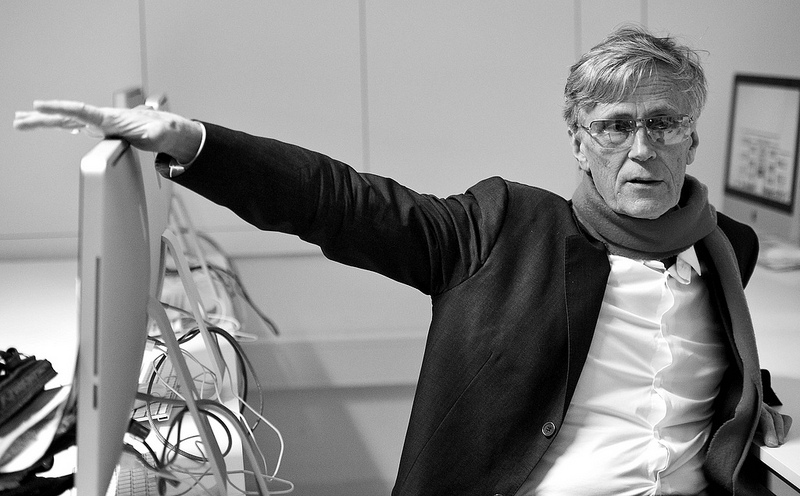
Although being almost 70 years old, Derrick de Kerckhove has a vitality and an energy that many people under 40 would want for themselves. Derrick, who used to work closely with Marshall McLuhan, is now a Professor of the French Language department at the University of Toronto and of the Sociology department at the Federico II University in Naples, scientific director of the Italian magazine Mediaduemila and research director at the UOC. We meet him at the IED Barcelona in an apparently exhausting day: he has just landed from Milano, where he had arrived the previous day in a plane from Toronto; we end our interview after 10:30 pm and then he goes to meet some friends for dinner; and the next morning he is giving a lecture about Social Business Design at ten o’clock at the IED’s recently opened new headquarters and, after that, flying back to Canada.
You were born in Belgium but spent some of your childhood in India and Pakistan.
Only three years, but they were pretty important, because it made me develop a global sensitivity from childhood. I saw many levels of poverty which I had not been exposed to in Europe and I saw a completely different cultural grounds: there were the Hindus, the Muslims, the Sikhs… And I had a very strong contact, as a young boy, with the servants of the house where I lived. I got a democratic, global and multilingual system. I learned Urdu! I used to write in Urdu!
How many languages do you speak? You are Belgian, learnt Urdu, worked in Italy, we are now speaking in English…
I’m terrible at it. I only have English, French and a bit of Italian. I used to speak Spanish until I learned Italian, and now I cannot speak Spanish anymore. And I cannot speak Urdu anymore, it’s all gone.
As you probably know in Spain we have several languages besides Spanish, the same as in Belgium, Canada or India. What do you think about growing up in a bilingual country? Is it better?
Every twenty years they change their mind about this, but I am certain, from my experience and from the experience of my children as well, that having two languages is an enormous advantage. It gives you access to different fields of knowledge and sensibility. To have more than one language is a fantastic experience. It is very good for the development of the person.
Este artículo de nuestro archivo está completo para lectores registrados. Registrarse es gratis y solo lleva un minuto.


Pingback: Jot Down Cultural Magazine | Derrick de Kerckhove: “O controlas el lenguaje o el lenguaje te controla a ti”
Pingback: SemioticaStudio » Transmedia Literacy Seminar II – The chronicle
Pingback: Towards a Posthuman Life