


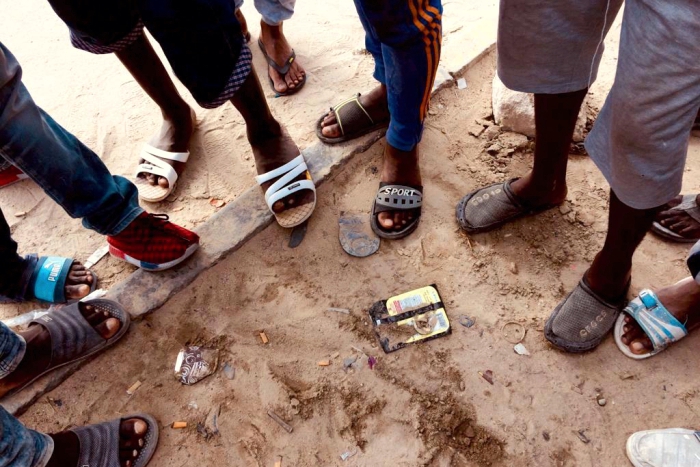
They are always there. On the road that goes from the monolith with a seahorse – the symbol of this city – to a mosque that the war left in ruins before it was even built. It is enough to greet any one of those who wait on the roadside for work in construction, cleaning, or anything, and a circle is formed in a matter of seconds.
After several years of working with migrants on my way to Europe, I’ve come across all kinds of profiles: from those who know the exact distance between their village in Congo and Paris, to those who are amazed with the immensity of the Mediterranean after seeing the sea for the first time. “I never thought such a big river could exist” – I swear I heard this from a rescue boat.
So, one of the objectives of this coverage in Libya is to know to what extent these people know the situation in the central Mediterranean. Do they know that Italy has closed its ports? Have they heard of Salvini? Has anyone told them that the rescue fleet is no longer there, or barely there, and that there is a powerful Libyan coast guard in its place?
Emile says he knows everything, but he has not seen what he has seen to return home now. Staying in Libya is not even mentioned, it is not an option for anyone. Since leaving home in 2015, this 21 year old boy has crossed Equatorial Guinea, Senegal, Gambia, Mali, Algeria, Morocco.. He tried to cross in Tangier, on ferries, and then by boat to Ceuta. On the third attempt, the Moroccan police took him to a detention center in Casablanca with many others. Once free, and after ruling out the Moroccan route, he would try from Libya, to which he would arrive after returning to the Algerian desert. The desert is rough, says Emile, who studied administration. He’s good with numbers.
Returning to the desert, he tells us that from the back of a truck you see the dead and those who will be dead soon; People in the middle of nowhere who try to stop the vehicle to get on. But these things never stop until the engine breaks. Emile thought he was very lucky until the same thing happened to him. Hours later, someone in a van came to look for the driver, and he stayed there with the rest. In the middle of nowhere. He had five litres of water to share with four others like him; They endured a week that began with sips of water and ended with sips of urine. They tried to stop three trucks. They already knew that they would not stop, but they tried anyway.
Este artículo de nuestro archivo está completo para lectores registrados. Registrarse es gratis y solo lleva un minuto.

Pingback: – Day two: Trapped in hell – ESPANTALHO
Pingback: Día dos: Atrapados en el infierno – El Sol Revista de Prensa