


(Versión en castellano aquí)
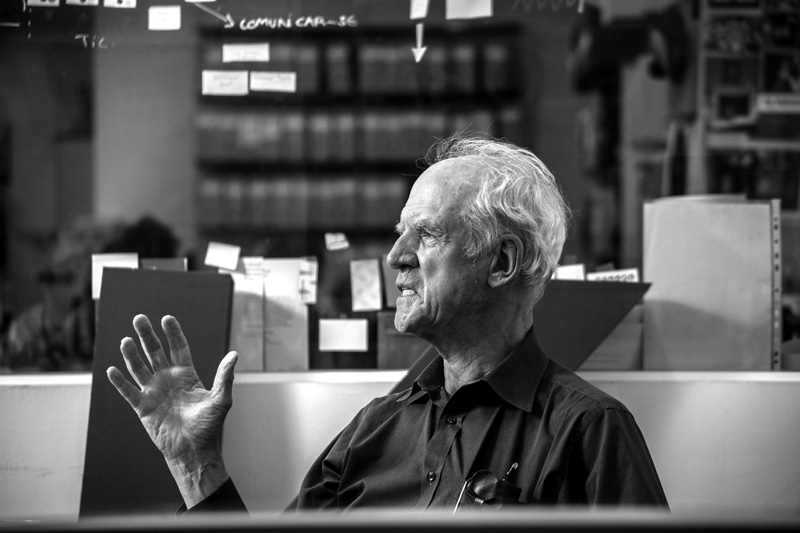
It would be an understatement to introduce Charles Taylor (Montreal, 1931) just as a philosopher. And that’s because this Canadian thinker has moved like a fish swimming in a stream between History, Philosophy, Politics and even Psychology, and in all these fields has made relevant contributions.
Taylor declares himself a supporter of Quebec’s own identity within a cohabitation between nations and in his different works about Modernity or secularism shows this conciliatory disposition while trying to build bridges between confronted positions like faith and reason. We seize the opportunity of his visit to Barcelona’s CCCB to talk about nationalism, the role of religions in modern society, conception of the self, or our natural tendency towards conflict and reconciliation.
A graduate in History, becoming a PhD in Philosophy, with a thesis about behavioral psychology, and being professor of political science. When did you have a clear idea about what you were going to do in your life?
Well, I’m getting close to it… [Laughter]. No, it happened as a series of accidents. I did a degree in History and then I got a scholarship with Oxford. So I thought that maybe I would go sideways and do Philosophy, politics and economics. And then I got very dissatisfied with the Philosophy, so I wanted to go on and do Philosophy. Then I was very influenced by Maurice Merleau-Ponty, a French phenomenologist. He was a companion of Sartre. Right after the war they were in Temps modernes, the magazine. Then they fell out for a variety of reasons. But I think he’s one of the really important seminal philosophers of the 20th century. He put together phenomenological philosophy with a study of the scientific literature. For instance, on the brain to develop an understanding of what human agency is. So phenomenology of perception is his big one. I read that when I was at Oxford. And I wanted to pursue it. So then I sort of pursued it and I did something Merleau-Ponty’ian. I had a discussion of the explanation of behavior, but in connection with a certain so-called scientific field of behaviorist-psychology, which I thought was a complete dead-end. But I wanted to show that it was a dead-end, so I did a sort of Merleau-Ponty’ian book and that became my thesis. And from then on I got interested in politics, so I joined a political science department. I was in the borderline between philosophy and the human sciences. And that, you know, led to whole lot of things: led to reading a lot of political science, a lot of Anthropology… and never lost interest in History [Laughs]. I gradually brought them down and I situated myself in this interspace between philosophy, sort of science and History.
Este artículo de nuestro archivo está completo para lectores registrados. Registrarse es gratis y solo lleva un minuto.


Pingback: Charles Taylor: «Los musulmanes sienten un aumento del rechazo, y eso es exactamente lo que el Estado Islámico quiere que suceda» - Jot Down Cultural Magazine
Pingback: Canada Immigration Montreal Address | CIC Canada Immigration
Pingback: Enchantment and Disenchantment in Taylor’s Essay “Western Secularity” – Parker's Pensées