

Report made with the support of Oxfam Intermón
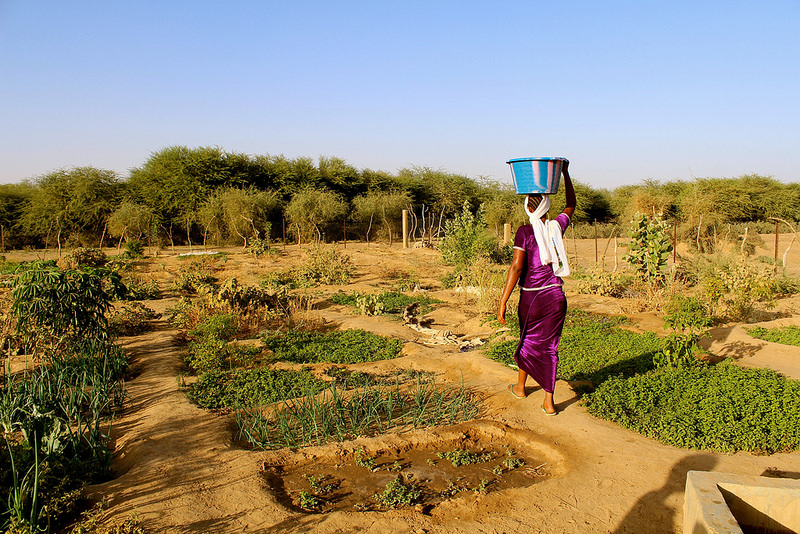
We travel many kilometres across a landscape that could not be more attractive. This is the African Savannah we all have seen in the movies as kids. There is no path to follow; only Orzoway is missing to calm European’s thirst for fantastic adventures. Nalla Gaye laughs and makes us laugh from the front seat of the car. He is explaining to us how he lost weight the summer his wife left him alone with the kids. He ran back and forth to go to the office, cooking, go shopping, cleaning…until he was as thin as a rake. These stories are somehow related to the women we are about to meet in Thethiane, region of Djeole, province of Kaedi, in southern Mauritania. According to Nalla, who works for Intermon Oxfam in Kaedi, these women are overburdened with tasks, and yet they are willing to progress, to learn, to start new businesses, to transform their society. Finally, we arrive at Tethiane, a little village where a group of women have opened a tiny factory for pasteurized yogurt. After collecting the excess of milk from their neighbours, who are most of them little cattle-raisers, these women produce, pack and distribute the yogurts. The last one is the most difficult activity because to transport the merchandise to Kaedi market, the capital city of the province, one must be very ingenious. From a shared car to a donkey-drawn carriage, they even get there on foot. After only few weeks of activity they have exceeded all expectations by far. Their cold storage unit, provided by the Mauritanian NGO Acor-helped by Oxfam and AECID (1) is already too small for their business. Their objective is to pass their modest current limit, which is 20 litres per day. For that, they need a pasteurization tank. When the rainy season arrives, animals will produce more milk, so these women, who have already waited a long time, can’t wait any longer to progress. Despite of the precariousness that surrounds them, of the rusticity of their adobe houses, where they live without neither tap water nor electricity, their children are the most outstanding pupils of the province. This little community believes in education as they believe in progress. They do a lot with very little. They just need a pinch of support on their way.
That’s Mauritania. When you arrive, it appears the whole country is being dismantled, that every activity finished a long time ago and that you’ve landed in a post-industrial era not too far from the one recreated in Sci-Fi movies. In Nouakchott, the capital city, there are trenches and holes everywhere. A thick layer of dust covers the ramshackle cars that run alongside shiny Japanese 4×4. They also share the roads with donkey-drove carriage, even if they look more like zebras. Between holes and paving stones, goats freely nibble at the plastic scraps scattered all over the ground. The absence of a garbage collection system is a widespread problem in Africa. It would be less stunning to visitors if such a natural beauty did not surround it. Almost all men are covered with colourful and sculptural boubous, the attractive blue or white tunics they wear over shirts and trousers. Boubous are made of very rough cotton, which sometimes looks like papier-maché. Some of them wrap also scarves and turbans over their heads to protect themselves from sun and dust, and to have an exotic and theatrical air. By paying attention to the variety of features, one can easily understand that many different ethnics inhabit this country. Light and dark skin moors coexist with the Haratins, descendants of African freed slaves completely arabized and integrated, and with black African Mauritanians like the Soninké, the Pulaar and the Wolof, all of them Muslims whose languages and own identities have been preserved. Such variety makes the country even more complex and interesting, and leads us to conceive it as a kind of future civilization: one could not be surprised by bumping into a pair of androids. Maybe we have already got into the Star Wars Cantina without noticing it.
Este artículo de nuestro archivo está completo para lectores registrados. Registrarse es gratis y solo lleva un minuto.

Pingback: Mauritania, la pobreza innecesaria
Pingback: Mauritania, la pobreza innecesaria | Mediavelada