
French/English Interpreter: Brian Valente-Quinn. Wolof/French Translator: Babacar Thiaw
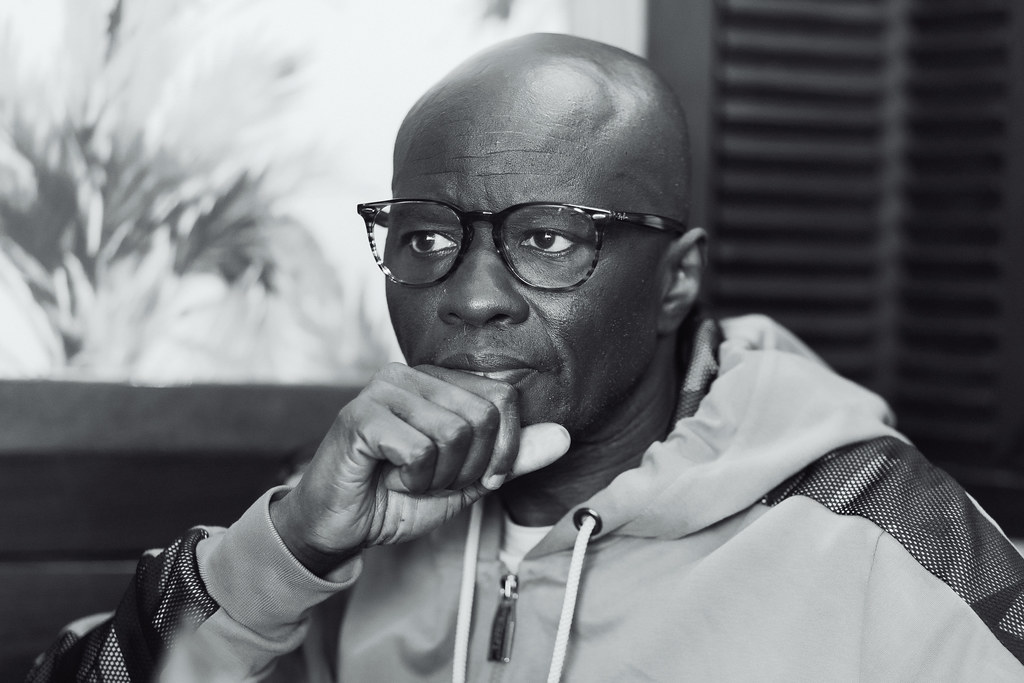
Omar Pene, co-founder and lead singer of the Dakar-based supergroup Super Dianomo, has been composing and playing for 50 years, releasing albums both with Dianomo and as a solo artist. The style he helped invent fuses traditional Wolof percussion, multi-ethnic religious music, soul and blues styles into «Mbalax,» a genre that dialogued with Cuban music and eventually supplanted it as the dominant pop music in Senegal in the years after that country’s independence. A long-time advocate of Pan-Africanism, his contributions have been recognized by ECOWAS (the Economic Community of West African States). Pene has been sounding the alarm on climate change and the increasing desertification of Senegal for years, and he released the thematic album «Climat» in 2019. Pene is also a Goodwill Ambassador to Students on behalf of President Macky Sall’s government.
Shall we talk about mbalax music, Wolof music, Senegalese music, African music, West African music, or just music?
We can simply talk about music.
How important is the Wolof identity in your life and in your music?
I am Senegalese, I was born Wolof; it is my mother tongue. That’s why it’s such an important tradition for me, because it’s a value that we want to transmit. Because the English sing in English, the French sing in French and the Wolof sing in Wolof.
How did you start your musical career?
I started when I was very young, but not in an orchestra. I sang in the street with friends, for fun, because I really wanted to have a career as a soccer player. I became a singer by chance. A man who lived in my neighborhood and was part of a group called «Le Kad Orchestra» heard me singing like that in the street, and he asked me to join his group, and of course I wanted to…. I had a voice, even though I’m not a griot, because usually it’s the griots who sing. At that time, I wasn’t interested. I wanted to play soccer, period. But my friends asked me to go try out, because there were a lot of soccer players in the neighborhood, but no musicians.
I’ll tell you an anecdote that is quite humorous to me: One day, I was coming back from training – we were playing soccer – and I showed up at the place where the band I wanted to join was rehearsing. As soon as I showed up in my soccer gear, the director wanted to throw me out. But the man who discovered me said, «Oh no, it’s that guy I told you about. I’ve heard him sing, he has a [nice] voice, so we can try him out. I did the audition and they said, “Yes, we’ll see him again.” A week or two later, the man came back to tell me: we have decided to accept you in the group because we need a young singer who can sing in Wolof.
Este artículo de nuestro archivo está completo para lectores registrados. Registrarse es gratis y solo lleva un minuto.
Pingback: Omar Pene: «A través de los ritmos intentamos crear una música que sonara a nosotros, que tuviera en cuenta el arraigo y la apertura» - Jot Down Cultural Magazine
Pingback: Omar Pene: “On a essayé de par les rythmes de créer une musique qui nous ressemblait, qui tenait compte de l'enracinement et de l'ouverture” - Jot Down Cultural Magazine
Pingback: Omar Pene: «A través de los ritmos intentamos crear una música … – Jot Down – Lavozhispana: Información que trasciende los titulares
Pingback: Omar Pene: “Dañoo jéema boole ay tëgin ngir am sunu yëfu bopp, fent ab misik bu mengoo ag lu Senghoor daan wax sampu ak ubbeeku” - Jot Down Cultural Magazine