


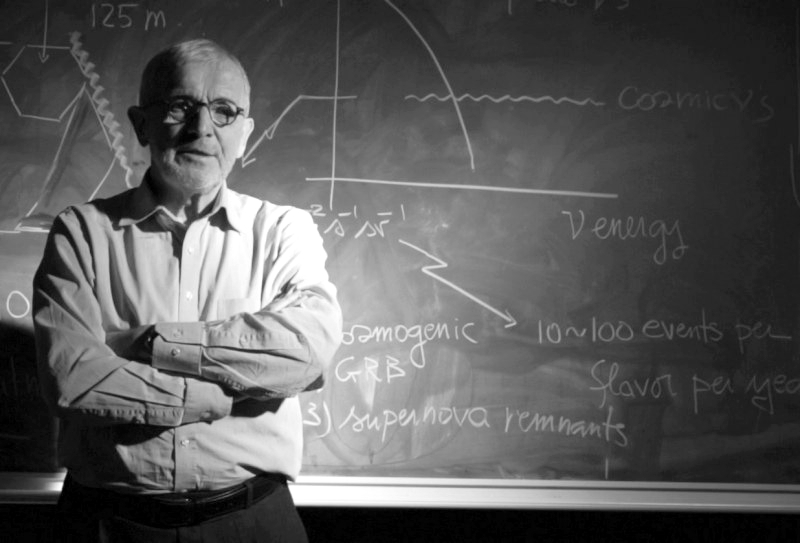
Francis Halzen looks at you straight in the eye. Arms folded across his chest, an almost ironic smile dangling in his lips, he stands relaxed and self confident, cordial and dignified. But there is something else about this respected theorist, turned spokesperson of the hottest experiment of the year, ICE CUBE, the gigantic neutrino telescope in Antarctica. It takes me a while to realize what it is, but then is obvious. This friendly gentleman is dangerous. He belongs to a special class of scientists, the predators, who won’t stop hunting Nature until She will yield. Indeed, I can imagine that he introduces himself as: “my name is Halzen. Francis Halzen”. Yes. Agent 007 of Physics.
We have the pleasure to interview today Francis Halzen, the spokesperson and the leader of the ICE CUBE experiment, who is of recent fame for the discovery of extraterrestrial (possibly extragalactic) neutrinos. Francis, please, tell us when and how you come up with the idea of building a neutrino detector in the South Pole.
Well, I’m not sure if I can reconstruct everything, but there were two main ingredients. The first was that I knew about the DUMAND project, which had spelled out the idea of building a large neutrino detector, based in the Cherenkov effect, instrumenting a large volume of natural water. The concept was originated in the nineties’ in Russia, but the first serious attempt to do such an experiment was in Hawaii, where they wanted to put a detector (called DUMAND) about four kilometers under the sea level, off the coast of the main island in Hawaii. Although I never participated in that project, I knew everything about it because I worked with theorists in Hawaii, and I found myself going often for lunch with the people working at the DUMAND project. The second ingredient was that I was working on detecting neutrinos in ice with (the Spanish physicist) Enrique Zas…
With our very same Enrique Zas, from University of Santiago de Compostela?
Indeed! He was at the time a student in Madison, and we were working on the idea of detecting neutrino radio emissions in ice. When the neutrino interacts, it actually emits Cherenkov radiation in the Gigahertz band. The concept had been suggested by (the Russian physicist) Askaryan in 1963, but the original papers had not shown what the power of the signal was, apparently because, at the time, the Russians didn’t have enough computer power. In fact it was a hard problem, which Enrique solved brilliantly. But on the other hand, I knew about DUMAND, and since we were working on radio in ice, combining the two ideas was not a big deal, right? And so, the possibility of building a neutrino detector in ice was born.
Este artículo de nuestro archivo está completo para lectores registrados. Registrarse es gratis y solo lleva un minuto.


Pingback: Francis Halzen: «Siempre aconsejo a mis estudiantes “¡no leáis demasiados libros, haced cosas!”»
Nice interview, I learn quite a lot from Halzen’s textbook. Met him years ago in a summer school. Really great guy.
One minor correction. I doubt Askaryan was Russian. His surname is Armenian. Wikipedia says he was born in Moscow, but clasifies him as Soviet Armenian.
Private information bags which no more than the pros were aware about.
Washington Redskins #59 London Fletcher Elite Grey Shadow Men’s Nike NFL Stitched Jersey on sale,NFL-Washington Redskins http://www.b-a-o.com/New-York-Knicks-7/Washington-Redskins-59-London-Fletcher-Elite-Grey-Shadow-Men-s-Nike-NFL-Stitched-Jersey-on-sale-NFL-Washington-Redskins-21fe.html