


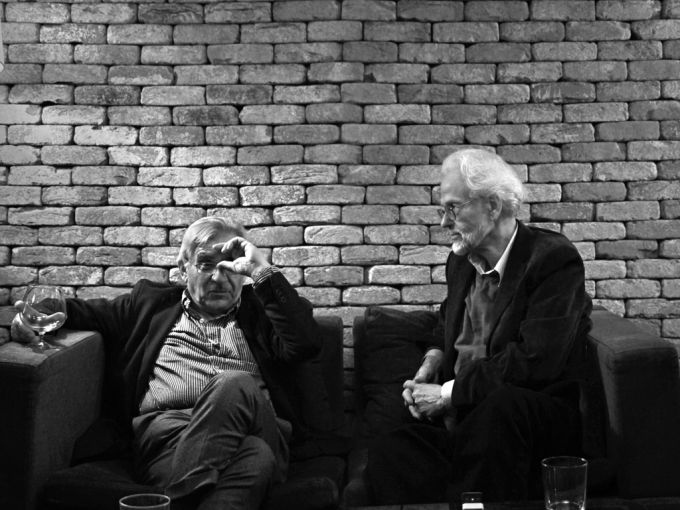
Not every day one has the chance to have a conversation with such reputed physicists as Alessandro Bettini and David Nygren. The equivalent, if we were dealing with musicians, would be to interview Bob Dylan and Leonard Cohen, or perhaps Jagger and McCartney. These two old rockers -both aged close to three quarters of a century, although you wouldn’t tell from their looks- represent the cream of the crop of particle Physics in Europe and the United States of America. They are joined by (in his role as sorcerer’s apprentice) Juan José Cadenas, director of the NEXT experiment, frequent collaborator and groupie of these two heavyweights.
Alessandro (Sandro) Bettini has held during several decades a chair in the same institution as Galileo Galilei did, namely the University of Padova. He is one amongst the exquisite school of italian physicists, direct heirs of Fermi and his ragazzi da Via Panisterna. A scientist of international renown, Sandro has also been director of the Laboratorio Nazionale di Gran Sasso, the LNGS, a sort of elder brother to the Laboratorio subterráneo de Canfranc (LSC) which he currently directs. The signing of professor Bettini on behalf of the LSC, going back to metaphors, would equate the miracle that would allow a combative Getafe or Atletic to steal a football player like Cristiano Ronaldo from Real Madrid.
And if Sandro Bettini can be compared to Ronaldo, we can only compare David Nygren with Messi. We are talking about someone who for many is the best instrumental physicist in the field of nuclear physics and high energies worldwide. A distinguished scientist from the Lawrence Berkeley National Laboratory (LBNL), an institution that has had within its ranks no less than 13 nobel prize winners in Physics (to be compared with the resounding spanish amount of zero). Thirteen which could be fourteen any of the forthcoming years, since Dave is a more than obvious candidate to the coveted prize.
His most well-known success is the invention of the Time Projection Chamber (TPC) in the mid-seventies. This device (basically an electronic photographic camera used to measure paths of subatomic particles) is used, nowadays, in big experiments in the LHC, and has found applications in fields such as medical physics and is the foundation of experiments like NEXT, designed to look for double beta neutrino decay. But Dave, like Messi, is not a player who is in the field to stay idle, not even at his 25×3 years of age. He has invented the instrument and now wants to play with it, to see, like Galileo, the craters of the moon. And his TPC, incarnated in the family of experiments of which NEXT would be the first generation, has the ambition to prove that the neutrino is its own antiparticle, or detect the trace of a particle of dark matter.
Este artículo de nuestro archivo está completo para lectores registrados. Registrarse es gratis y solo lleva un minuto.



Pingback: Jot Down Cultural Magazine | David Nygren y Alessandro Bettini, la física como fuente de la eterna juventud
Pingback: Francis Halzen: “I always advise to my students ‘don’t read too many books, do things!’”
Pingback: La evolución del universo y el descubrimiento del primero de los exoplanetas se llevan el premio Nobel de Física 2019 - Tec Ofertas España